Wednesday, April 27, 2011

Tuesday, April 19, 2011

The Death Star wasn't Agile – and other Imperial failings …


This started as a joke I put up on Twitter, but the more I thought about it, the more I feel how we could learn a bit from the Empire, by looking at how they run projects, and how not to fail like that in our teams.

1)  Death Star Vs Alderaan


The Death Star is a planet killing ultimate weapon.  Woot!  And part way through Star Wars IV A New Hope, it appears above Alderaan, and blows it to smithereens.  

This Governor Tarkin claims this is the first demonstration of it's firepower.

Now if this was a truly Agile project, then in the first part of the film, the Death Star would have gone around blowing up an asteroid first, then a small moon, before moving onto Alderaan, to effectively show the capability of it's destructiveness in a couple of iterations.

Okay so the Death Star worked - but what if it hadn't?  Instead of feared throughout the galaxy it'd have been on the "and finally" section of the news.


2)  Getting the Death Star working


There is a gap of 20 years between the films Revenge of the Sith and A New Hope.  In A New Hope it's said that the Death Star is only just operational.

And yet in Revenge of the Sith, the Death Star is shown under construction – that means they took 20 years to finish it and work the bugs out of the system!

Ever heard of deadlines?  C'mon we've got a galaxy to run here!

3)  Blowing Up The Death Star


The plans of the Death Star appear in the second film, Attack of the Clones.  In A New Hope, the Rebel Alliance get a hold of them, find a weakness (the exhaust vent leading to the main reactor) and attack it.

Yes – it took over 20 years to get the Death Star working, but they kept to the original plans – they never went “wait a moment ...” and thought of a better way?

4)  Stand-Up Meetings


The Empire never got the hang of stand up meetings.  Look at this – only Darth Vader is getting into the spirit of it.  And even then he ends up force-choking another member.  Which is a novel way to keep meetings from over-runing.

5)  Armour Plated Solutions


In the Battle of Hoth the AT-AT walkers won victory over the Rebels landspeeders.  Ish.

The AT-ATs were better armed and armoured.  They won, they took out the bases reactor and shields.

But they were also very slow.  By the time they got to the reactor, the Empire had given their competition the Rebel Alliance enough time to get ahead of them and move on to a new base.

Had the Empire used landspeeders themselves, they could have quickly taken out the reactor, and wiped out the Rebels there and then.

6)  Embracing Failure


No-one in the Empire really learns from failure – as they often end up being force-choked to death.

This is particularly bad as sometimes the one to blame for Luke Skywalker getting away is Darth Vader himself.  Poor management.

7)  Hoping the Little Problems go away


On Endor, the Empire was plagued by little fury pests.  Rather than deal with them decisively, the stormtroopers just hoped they'd go away and not bother them.

In the end those pesky Ewoks ended up ganging up and becoming a giant problem which brought down the Empire.

When you can, exterminate those Gremlins before they gang up on you!

Friday, April 8, 2011

Communication - the better ways of doing it ...


So I've chewed out the "bad" ways we sometimes communicate - what are the good ways to do it?

The project I work on has got communication down to a T, and their rules are pretty good.  They call them Agile-ish or "pragmatic development".  Having got used to them, I find them pretty smart.

If you have a technical issue,

  • try and find the person you need to chat with, and talk
  • failing that, book a meeting
  • or else phone them
  • only if all the above fail, write an email
  • if you write an email - no more than three paragraphs.  Keep it short and to the point.  No massive lists, no more than a few points.
  • keep documentation brief and readable

We're trying to come up with new ways of displaying information.  For instance I have been talking with my Testing Learning partner from my old company.  We both have the same worries - you write your test plan, but does anyone read it?

A solution suggested from Agile Testing by Lisa Crispin and Janet Gregory is to produce a 2-page test plan of the salient points.  What I've since been working on was an idea suggested by a couple of people from the Software Testing Club - a mind map!

Basically at the moment (it's a crutch I know) I'm still writing out my traditional 12 page test plan, but supporting it with an A3 mind map based on an structure provided by Ivor McCormack ...


It's truly a thing of beauty isn't it?

I've used this for two projects so far and been amazed - I put this in front of a manager or developer, and within a couple of minutes we're cutting to the chase, and discussing testing effort.  It's that intuitive and easy for another party to pick up - success!!!


My study partner has also seen this, and taken it to use on her project.  I'd like to take credit, but it's a collaborative effort, and proof how testers through the internet can share stories and education to help each other.


At the moment the traditional test plan exists in the background, but I'd like to eventually move to just a mind map.  I don't know if it's possible, but it would really ease things if we could.  Everyone seems to love them, and it takes 5 minutes to pick up vs hours of review!

Tuesday, April 5, 2011

Project Communication


Over on the Software Testing Club I've been talking a little bit about communication within teams and it's been interesting to see how passionate the responses have been.

We've all been there – been given a series of planning and design documents for our project.  They're very long.  And dull.  And when you're reading it, it goes

“The system will readily maximise future leverage in the marketplace under the caviat that increased technical processing will accelerated – blah blah blah – oh this is so boring”

Yup – and there's usually about 60 pages in that vein!

Over the last few years I've read some truly mindnumbing documents.  We then send them to the customer, and get really irate they never comment back on them.  Or worse still when we deliver and they go “why does it do that?” we go “but we told you in that 400 page technical spec!”.

Why are we making it so difficult?  Let's step back from the problem first and ask – how would we as engineers solve a similar problem of communication if we were dealing with a technical computer based issue?

So like the SOA examples I've talked about previously we need two computer programs to communicate how would we deal with it?

First off we should be going “why are we communicating”.  Most communications fall into one of what I call “the 3 i's”


  • Instruction – telling another party to do something
  • Information – providing another party with data of some kind
  • Inquiry – asking another party for information


So whatever we're communicating for the computer, it had to fall into one of those.  If it's not, then it's just waffle / overhead, and we need to bin it.

We then take a lot of time thinking about protocol – we want the messages we send to another system to make sense there, and likewise we want the information we receive to make sense to us.  We also know that brevity is key – if we make messages unnecessarily long, we know it'll consume bandwidth without really delivering any kind of value or service.  If not, then once again it becomes an unnecessary overhead.

We are super-optimised when it comes to dealing with communications between systems.

Why then are we so bad at communicating with each other?

No really we are!  We're so good at the rules of communications on computer systems, we know its a complicated minefield, so we treat it with respect.

But we've known how to write since school and been talking since we were about two.  Easy peasy, it just comes naturally hey?

And so we run meetings which constantly run overtime, but don't go anywhere.  We write reports which are too meandering and too technical for the audience, and no-one reads anyway.

No – no – NO!

Let's try this again.

Every email, memo, report we write needs to be tailored just as we'd design a computer message.

We need to make sure it has purpose – that it either informs, instructs or inquires.

We need to make sure it has protocol – that it conforms to an easily understood standard by the intended party, and has the information they need without unnecessary length.  That it is targeted for it's intended audience.

We also to use plain English where we can.  Sometimes we expand what we write with buzz words and jargon because we feel it gives a certain grandeur and polish to what we say.  I know many a person who's a bit guilty of using a “posh word” in not quite the manner they really should.  Instead of looking clever, they look stupid, and this can also mean confusion creeps into what they're doing.

If not careful we can become like some aging thespian saying “To be or not to be.  That is the question.  Whether tis nobler in the mind to suffer the slings and arrows of outrageous fortune.  Or to take up arms against a sea of troubles, and by opposing, end them”.

Most kids if you said that to would go “huh?”.  However if you said “Look shit happens.  Either learn to take it or give some back alright?”, they'd go “ah”.    Targetting for the audience you see.

Some of you might say that's not proper English, but then (and no offence, as I love his work), neither is Shakespeare these days.

Let's keep it simple eh?

Tuesday, March 29, 2011

SOA Test tools ...

Yesterday I talked a little about SOA applications and "getting in there early to test".

Of course to do this, you need a SOA test tool - I've been lucky to get the opportunity to test a couple of these out (soapUI and HP Service Test) , and I'm going to compare and contrast them here.


soapUI

soapUI is a freeware tool to enable an application to be stimulated with XML messages, and capture the responses,


Typically for a freeware product, some of the supporting manuals for it seem to be lagged a couple of phases behind the current version.


However it has a vibrant and passionate community behind it, and also regularly has interactive Webcasts with the chief designers.  Alas over here in New Zealand, it means setting your alarm clock for unfeasibly early!


The system is fairly basic, but allows early testing (and it’s free).  Although need configuring to your application, and isn’t as user-friendly and easy to build up tests as with HP’s Service Test.


HP Service Test

As would be expected for a paid for HP tool, Service Test delivers a lot more than the functionality available for soapUI.

A trial version should be available to find your feet on this application.

The best method to learn how to use this is to work through the HP Service Test Tutorial rather than wading through the User Guide – which is quite dry and lacks the context of the Test Tutorial.  When coming to the exercises on using the Sample Application – you might find you need to run this application as an Admin (esp on Vista machines) in order to run properly, otherwise Windows will block this from working properly.

Tests can be built up using the graphical flow, which can be built to mirror the portions of any flow chart.  It’s also relatively easy to build up tests by dragging and dropping functional blocks into place on the test flow.


There is also (as with many HP tools) the ability to drive tests from data in Excel spreadsheets, which can increase the scope of the automated testing you can achieve.  This is useful – using the tool to recreate the flow chart of design, you can basically data-drive your tests, meaning one well written test can cover all your bases, rather than designing potentially dozens of individual tests.


So the big question ...


Which one would I use?  Well to me undoubtedly HP Service Test is the one I'd really like to use if I was to extensively test a SOA application.  There's just so much you can do with it, you can extensively test instead of the snapshots you can manage with soapUI.


But ... the reality of HP Service Test is it's expensive, and getting a manager to sign off on something like that when there is a free tool available?


As I've said before, the advantage of free tools are "hey at least I've got something", but the disadvantages can be it's that much harder to convince managers to pay out for the right tool if there's a free tool.  If you're going to buy in HP Service Test then you have to justify that you'll be doing a lot of SOA testing for your service.  That means hand on heart you should be working on a program of work for at least a year, with a lot of regression testing.


If you're just testing early on one application before delivery - soapUI is the way.  And if you're thinking of giving soapUI testing a go, then it's free!  No excuses, just download, and get playing with it, get interacting on the forums, and see if you like the feel of it.


If you do - tell a friend!

Monday, March 28, 2011

SOA Testing: An Introduction

What is SOA?

SOA stands for Service Orientated Architecture.  It’s a way of building an IT system that uses a series of separate executables which communicate with each other in what’s called a service layer.  To an outside user, the ‘join’ between these individual executables is invisible, and they seem to work as a single application.
There are many ways these executables can communicate with each other, but the most common method is to message each other using XML language.

Example of SOA

Lets take an example of a basic people-based database record system.

You can login as either an,

  • Account Manager – a user who manages the accounts of other users who access records, however does not have access to the records themselves.
  • Record User – a user who can access people records, and create/retrieve/update/delete people records as required.

From a system tester perspective, the system is a single black box application, and it’s used as a single entity in testing.

However looking at the design level – the developers have implemented it as 4 separate applications;


  • LogIn – Verifies account name and password, and allows a validated user to login as either an Account Manager or Record User
  • AccountsMan – An application that allows the user to create/retrieve/update/delete a user account.
  • HCI_RU – The human computer interface or “front end” to the Record User application.
  • MDB_RU – The “back end” application which handles record data, retrieves data from the database, verifies the data provided etc.


Testing an Application with a SOA tool

To test a SOA application, instead of testing all the applications together as is common practice within System testing, we can perform earlier testing on each individual application.
The emphasis on this to test an executable application in isolation, sending a message to it, and analysing the expected response returned from it.
In our example, we’re going to test the MDB_RU application – but we don’t have the HCI_RU (front end) ready yet.  So we’re going to use a SOA tool to send messages to it, and analyse the response.


The SOA Tool used to test this can be a dedicated bespoke test harness.  But such test harnesses can often be as expensive to build and maintain as the object under test.
Increasingly there are also dedicated SOA tools available to aid with testing such as soapUI or HP’s Service Test.  These are tools which are ready to handle sending and retrieving messages to a target port on an application under test.  Although most of the work for these is done, they don’t just work “out of the box” and will need to be tailored according to the application design and interface specifications, with possibly a developer aiding.

Using SOA tools can be a fairly technical form of testing – and will require some understanding of the messaging system.  For our example which uses XLM messaging, we create a test message to ask the MDB_RU to search for records for people called “John Babcock” and return any records …

Input message

<HCI_RU_msg>
                <header>Search</header>
                <searchKey>
                                <firstName>John</firstName>
                                <lastName>Babcock</lastName>
                </searchKey>
</HCI_RU_msg>

Output message

<RU_HCI_msg>
                <header>SearchResults</header>
                <numResults>2</ numResults >
                <results>
                                <firstName>John</firstName>
                                <middleName>Lee</middleName>
                                <lastName>Babcock</lastName>
                                <dateOfBirth>02/03/1970 </dateOfBirth>
                                <IRD_num>102365846</IRD_num>
                </results>
                <results>
                                <firstName>John</firstName>
                                <middleName>James</middleName>
                                <lastName>Babcock</lastName>
                                <dateOfBirth>15/09/1979 </dateOfBirth>
                                <IRD_num>012456735</IRD_num>
                </results>

</ RU_HCI _msg>

SOA testing exists in a “grey” area.  It’s not the pure black box testing of waiting for all the applications to be put together as an integrated system and testing the whole thing.  But neither is it truly white box testing – you don’t see the internal logic/actions within an application, just it’s responses.

Advantages of SOA Testing

In most environments, system testing can only begin once all applications are available an integrated into a test environment.

In reality though, different applications ready at different times – so in our example for instance, the the MDB_RU appication is completed 3 weeks before the MDB_HCI application is ready.  Traditionally without this we’d not be able to begin testin.  Being able to test the MDB_RU application using SOA will help identify any bugs early, and get the developers working to resolve them. 

One of the fundamental rules of testing states the earlier a defect is discovered, the less it will cost to repair it – this is the strength of SOA testing.

In addition it also allows testing in isolation.  When our example application was system tested, it retrieved someone’s details, it displayed someone’s date of birth as “00/00/0000”.  Is it the front end (MDB_HCI) or back end (MDB_RU) which is at fault here?  SOA testing would allow us to test each separately to determine the application at fault.  In our example it could be the back end is sending blank data because the client record has no associated date of birth, and thus the front end is interpreting null to be 00/00/0000.

Disadvantages of SOA Testing

Even using tools like soapUI or HP’s Service Test, SOA testing is more technical.  It also involves  more of a learning curve to get started, including a more detailed understanding of the “nuts and bolts” of how the applications are designed than in system testing.

It’s not a complete substitute for system testing, rather an exercise that can support it.  Each application can be tested to perfection in isolation, however it’s only as integrated that the end system will be delivered.

Finally one potential danger with testers taking on SOA is developers not testing their work sufficiently, feeling the SOA testers will pick up if they’re any problems.  This might not be a problem if builds can be created quickly – however if builds are only available once a day, this could mean a bad build knocking out all work for that entire day.

My Personal Experience

There is no doubt that SOAs like Clouds are becoming increasingly popular in solutions.  I've done testing on a couple of them - you're seeing SOA concept being utilised more and more, for instance when one Government department (such as healthcare) is trying to link into another (social security).

I recently introduced a test department to SOA testing using the basic SOAP UI.  The back end processing components were "ready for testing", but the front end wouldn't be ready for about 4 months.  Using SOAP testing tools, the team was able to test NOW, find problems NOW, have defects fixed NOW.  It was a pleasure to see a team really see the value of the tool in a big way, a real "road to Damascus" revelation that there were other ways to test using SOA and test early.

Friday, March 18, 2011

Cometh the Cloud - what's it all about?

Last year I compiled a report of the spending of the top 100 IT companies in New Zealand, and I happened to notice two conspicuous trends...

One of which was to do with companies increasingly trying out Agile methodologies to deliver to market – and I've talked a fair bit about Agile elsewhere (and will continue to do).

The other trend was about companies seeking more CLOUD solutions – a term I was completely unaware of at the time, though I've been reading about it ever since.

So this is a brief introduction to “the Cloud concept”.


In order to describe it, I'm actually going to go back into computer history, and show really the Cloud concept is something quite old, that's come back in fashion, but with a modern twist.


Gonna party like it's 1969 …

Yes, in the 60s and 70s, computers were big and expensive.  If you were lucky, your company could afford a single large computer to serve their computer needs.


This large computer would act as a server, and you'd have multiple terminals connected to them that looked like this …


These terminals were pretty dumb, they were essentially just a keyboard and a monitor.  Any commands you ran on it, were really run on the server.  They functioned just as a way to run programs on the server for you, and would show you the results.

In fact the server itself probably didn't have any direct access to it except through these terminals – it just sat there doing it's stuff, and you could monitor or command through the terminals.

Cometh the home PC

All this is very nice, but without any internet as we'd know it, this meant computers were limited to just large corporations who could afford such expensive servers.

Then along came the home PC …


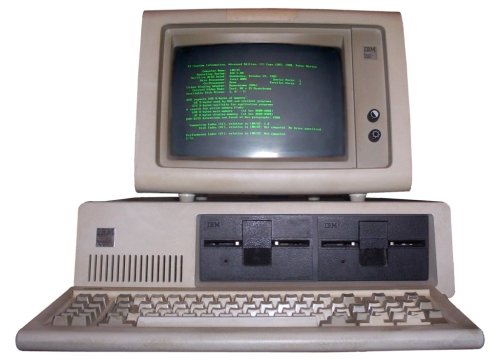
They might have looked a bit like them, but these were no “dumb” terminals!  IBM were first, but those of us of a certain age still remember “our first” be it something like the BBC Micro, Commodore 64 or ZX Spectrum.

What these machines allowed was something much smaller than the server model – they didn't need a network connection to a more powerful machine, they could handle all the processing internally, and had a few peripherals like a floppy disk drive and printer if you were lucky.

They took off, with every home and small business could suddenly afford a home PC of some kind, and people found them useful for doing all kinds of things.  Computer software and games became a huge industry, supplying what you needed to harness the power of your machine.


But then everything changed …

Along came the internet!  And suddenly we started creeping back the other way.  We could do things on our home PC, but then connect up to a larger network and share what we'd done.  We could have the best of both worlds.

When I first got an internet computer in 1999 I tended to do a lot of work offline, but then upload and share any information I needed to, then go offline again.  These days my computer goes on, and I connect online immediately, and if I'm not online (dodgy New Zealand internet connections) I don't feel I can fully realise my computer!

So the Cloud

Well the Cloud is a lot like the old 70s computer model, with a few small differences.

You have a server, which can be anywhere in the world, and you connect to it via the internet.  On this Cloud server you can run many different kinds of programs, only instead of using a VT terminal to access the Cloud server, you use most likely either a web browser or some bespoke software (which to all extents is functioning like a web browser).


Heck even better in this modern age – you can even use something like your smartphone to access the power of the Cloud.

So what can you do there?

Well pretty much anything.  You know when you're sending Hotmail and using the web browser application to organise your mail, you're using a Cloud application!  Likewise, you can write up documents in a Cloud application, and they're kept there.

Here's the good stuff

Being in the Cloud, the data on these servers is accessible to you from anywhere.  The benefits of this are …


  • Mobility of your data.  Ever done work at home and forgotten the USB drive you were working on?  D'oh!  If you're near an internet connection you can access your data.
  • Backed up and safe.  Yeah as long as you have a strong password of course.  We've all had computers that have had the hard disk fail for some reason.  And no matter how good our backups we almost always lose some data.  My best friend Violet actually had a nervous breakdown when her disk died and she lost all her art coursework.  It's very upsetting and costly.  Many of us back up our digital photos, but in a fire at home, it's likely we'll lose both our originals and the backups.
  • Secure.  We've all heard the stories of someone losing a disk of important information on a train.  When we carry media around with us, it's always in danger from theft.  And we rarely password protect or encrypt it as we think it's not going to happen to us.  With documentation in the Cloud there's no risk of physical theft.  Though of course there's the spectre of the hacker to deal with.


Course it's not all quite that easy, there is internet security.  If you're a company buying a Cloud solution you need to make sure there is a backup server, and that the backup server is located “elsewhere” from the primary one, so in an earthquake or tsunami like in Christchurch or Japan, you continue to function your business. *

One of the leading lights in providing Cloud service at the moment is Xero, an accountancy application that allows you to keep track of your business incoming/outgoing records.  Definitely a company to watch,


But more than likely there'll be a Cloud Camp event somewhere near you this year where you can talk with others about Cloud and what they're up to "in the Cloud" ...  These events can be a lot of fun, and are driven by attendees, AND FREE!  So no excuse ...


*  That seems cruel to talk of business in the face of such tragedy I know.  But I worked for a bank during one of the Christchurch earthquakes.  They worked tirelessly to get ATMs working, to provide people in Christchurch with immediate extra credit – simply because giving people access to resources to help them through such difficult periods meant that society didn't fall apart and descend into lawlessness (if people can't get money or buy what they need, they tend to try and take it), which would have cause more deaths.