Showing posts with label Time. Show all posts

Thursday, September 22, 2016

TIME 3 - Time under duress

You're still with me?  Great.  Buckle up, because time is only going to get wierder.

Thank your uncle Albert for that...


Albert Einstein is of course famous for a couple of theories of Relativity which describe interactions between energy and matter, and particularly discuss how time changes with speed.  It also imposed a speed limit on the Universe.

And I mean an absolute speed limit.  Not like where we have a 55mph road, and you do 56mph and feel all ...


You can't go faster than the speed of light.  You don't get to play Spinal Tap, and do the speed of light ... plus 1.

And as my reader Ben pointed out, there's certainly no going .5 past the speed of light.  Also a parsec is a unit of measurement not time.  Your dad's been lying this whole time kid.


Let's try a thought experiment

Okay - we have the scenario below,

  • Star Destroyer - slow enough to be considered stationary
  • Millennium Falcon - moving away from the Star Destroyer at half the speed of light.  It is also firing it's forward laser cannons, the energy for which moves at the speed of light.


Let's look at it from the point of view of a couple of observers.


Darth Vader is on the Star Destroyer, and he can see the Millennium Falcon moving away at half the speed of light.  He can also see the laser beams which also are moving away from him at the speed of light.

The lasers go no faster for leaving an object which is already at half the speed of light.  You would think this would be a good case for .5 past the speed of light.  But no, the speed limit still applies for any observer.
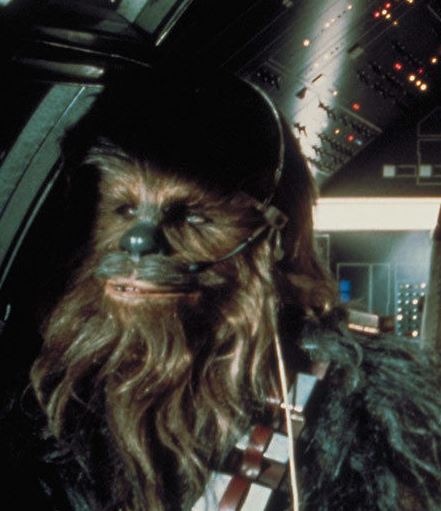

Chewbacca is flying the Millennium Falcon.  I guess you can say he's flying it Hans-free.  Surely he sees the laser beams travelling slower?

No - he sees the laser also travelling away from him at the speed of light.  How can it be that two people at vastly different speeds are seeing those lasers travel at the same speed relative to their speed of motion?


The answer is they're observing time very much more differently.  For Chewbacca, time is going much slower than for Darth Vader.  That different is enough for the light to look like it's moving at the speed of light from his slowed-time framework.  This is called time dilation.

It's just a fancy theory isn't it?

All this of course sounds like a fanciful theory, with a bit of mathematical jiggery-pokery to make it work on paper.  Except science doesn't work like that (you're thinking of religion).

All my critical thinking senses are dubious.  As I've said to my office quite regularly, I'm a tester, I don't tend to overthink things when I can come up with an experiment to prove or disprove something.

Once Einstein had written his theory, it was up to physicists to look for proof ... and they found it!


Muon

We obviously don't have spacecraft capable of travelling quite so fast as the Millennium Falcon - but we have the next best thing ... the mighty muon.

Muons are an exotic subatomic particle.  It is pretty much a heavy electron - it has the same charge, half the spin, but 300 times the weight.

They're also highly unstable, with a mean life of 2.2 microseconds - that's 0.0000022 seconds - observed in the lab.  It decomposes into an electron and a couple of neutrinos.


They're found in nature - when cosmic rays (essentially high energy protons or helium nuclei) from outer space collide with the atmosphere they can create muons.  These muons are moving incredibly fast - 95 to 99% the speed of light.  But even at those speeds, the best they could travel in our atmosphere is about 600m.

So how are these particles, produced miles above us, able to be detected on the ground?  When we do the analysis, and apply relativity, this isn't surprising.  Moving at that speed, the particle has experienced much less time - and as we talked in part 1.  That means less change has occurred - so these particles reach the ground having yet to decay.

This brings us right back to part one.  We can't measure time, but we can measure change, which can give us an indication of time.

You can read more about other observations of time dilation here or can see the maths being explained a bit here.  It's not just a theory, we've managed (by thinking about it, and applying a little cunning) to do some neat experiments to observe it.


So what was the point of the "Time"series?

When I saw Jasper Fforde earlier this year, he talked about writing as a mental challenge.  To take an idea and work out how far you can explore and push things.  Start with something, an idea or definition, and keep pushing.

After seeing definitions like this ...


I wondered if I could take something that I knew, try to define it, explore the definition, try new things as I learned.

This thirst to think and play with ideas - I'm not sure if it's exclusively a critical thinking thing.  It's definitely a science thing.  But it's something that drives me a lot - why so much of this blog is about playing with ideas to understand them better.

This blog series was actually originally written several months ago - and part of the reason I've thought very hard about trying covering more science in my spin-off I've talked about here


Now Playing - "To Love Somebody", the amazing Nina Simone


Wednesday, September 21, 2016

TIME 2 - Time under test

Okay - so previously we took a little look at time and defining it.  I put forward that this was the best I could come up with ...

Mike Talks' Definition Of Time

Time - a phenomenon which allows change to occur.

That is to say, without time, a system will remain in stasis.

Today I want to explore some meaning to that definition.

Measuring time?

Well as I mentioned previously, we can't measure time, but we can measure change.  It seems fair to say that the more change you're observing, the more time has elapsed.

If I went to the bottom of my road and counted cars passing me as my "change" to monitor - is seems fair to say I'd expect it to take longer to count 1000 cars passing me than to count 10.  But to know for sure I'd need to be able to check it against something I could be certain changes consistently and regularly.

Some of you might say "well just check with a stopwatch" - to which I'd remind you from last time, all the stopwatch is doing is counting oscillations in a quartz crystal.  So how can you be sure that's correct?

Synchronizing watches


These days with smartphones which autocorrect the time regularly, we're losing touch with synchronizing our clocks.  Even the best watch in the world can be inaccurate and drift a little - typically the more accurate, the more expensive.

But even this requires us to synchronise our device with a reference clock which we believe to be accurate,
  • When I was young we used to have a series of radio pips on the radio to tell us when the hour was on.
  • We could ring up the speaking clock on the phone
  • Towns in England would use the chimes of a town/church clock or a time ball to make aware the turning of the hour

The faulty clocks conundrum

Consider this as a challenge - you're given two clocks and told that whilst one is accurate, the other isn't correctly keeping time.  How do you work out which of the clocks is faulty?

There isn't actually any way I can see to solve this puzzle - if you leave both clocks running, one will be fast, the other slow.  There's no way to tell which is the accurate and which is the faulty one without somehow having a third reference time which you know to be accurate.

It's possible that one is running so incredibly fast/slow that you can tell by watching that "that's not ticking correctly", but you're not really using the second clock.

By the way - I typically hate these kinds of puzzles. If someone knew one clock was accurate, why ever the hell didn't they label it as such?

How do you actually test a clock?

Actually this has made me want to look a lot into "'how did people test the accuracy of clocks"?

This took me to the story of 18th Century inventor John Harrison, who tried to create an accurate naval clock or chronometer for measuring longitude.  Typically a large clock of his period is designed to be accurate, but completely stationary.  Smaller pocket watches existed, but it wasn't unusual for them to lose as much as fifteen minutes in a single day.

The challenge in a chronometer was to create a device which could move on the rolling, salt heavy, humid conditions of the sea, but retain accuracy of a large stationary clock.

If on a long sea voyage you knew London time, and you measured the time of midday, when the sun's shadow is smallest and points due north (in the Northern Hemisphere anyway), then for every hours difference from midday London, you were 15 degrees of longitude from London.  Read here for more detail.

Through experimentation, he turned a lot of ideas on clocks on their heads.  Many believed clock accuracy was down to using slow moving, heavy pendulums, where John Harrison found smaller, faster moving parts worked better - indeed a longitude watch could keep better time than a clock, as was proved by his experiments.  [His chronometer was noticeably different from normal clocks/watches from it's rapid tick-tick-tick]


John Harrison typically spent over 31 years building and testing a series of devices.  One such test involved sending the H4 watch overseas to Jamaica with his son, where it was found to only lose a few seconds over the 6 week voyage.

What's somewhat frustrating looking through all the information there is on John Harrison - there's a lot documented on every revolutionary feature he incorporated into his device, and how they were made.  But only a few clues as to how they were tested - this was annoying because (a) I'm a tester and (b) the devices can only be as good as the tests used to measure them.

I had a go at trying to reverse engineer how this might have been tested, and came up with the following possibilities,

  • Checking noontime
  • Checking vs accurate land clock
  • Checking vs night sky


Checking noontime


One obvious method for checking a chronometer would be to synchronise the device to twelve noon using a sundial to measure when a shadow is smallest / Due North.

You wait for noon the next day, and see if it's showing 12 o'clock.  The problem with this is it's quite a shallow test - and noon isn't something you can measure "to the second".

You can probably increase the confidence in this by running it daily over months, to see how much it shifts.  This is probably why Harrison spent 31 years testing!

Fundamentally with this, you're using one source of change (the hands on your watch under test), and testing it against another source (the time it takes the Earth to rotate), looking for correlation.

Checking vs accurate clock


This helps to give you a gauge, but as said above, how can you tell which of the clocks were "most accurate".  That said, such clocks run night and day, and someone would notice if the clock was striking noon when the sun was just rising in the morning.

Like the method above, this is another form of correlation testing.

Finding longitude of a known location

There are some records that show John Harrison's son used the H4 watch in Jamaica to predict the longitudinal position, and found after the sea voyage it was correct within a few seconds.  However of course - if the 18th Century lacked any means to accurately get the position of Jamaica (the whole point of the chronometer), how do you know the H4 wasn't measuring it more accurately than had previously been possible?

I suspected that Jamaica's latitude and longitude might have been calculate using the night sky - but again, there's a frustrating lack of information just on the internet about this. 


But which was it?

Don't you hate not knowing?  Thankfully James Bach recommended a book Longitude by Dava Sobel which solved this in.

It seems they'd found an accurate way on land to test time by observing the motion of the moons of Jupiter.  This was originally put forward by Galileo, but the astronomer Cassini perfected this with a series of tables (little did they know, there was an error in the system that Cassini corrected for, which turned out to be due to the speed of light difference due to different relative ranges between the Earth and Jupiter).

But this method of taking time could only be done by a trained mathematician/astronomer on solid land.  Hence knowing Jamaica's position relatively accurately.  Obviously only a few people had the skills to do this calculation, and it was completely unsuitable for use on the rolling sea.

Read more about this method here.


Addendum

I noticed that in 2015, a replica of the H4 was "tested"and found to keep time accurately.  You can read about it here.

Please notice my use of quotation marks there.  The replica was "tested" at the Greenwich observatory in a stationary location.  Part of the requirements of the chronometer for Harrison was that it to keep accurate time, whilst at sea.  So this isn't really an adequate test in my opinion.  [I'd have wanted to add in some rocking motion to the test]

Do you disagree?  Then comment below ...


Now playing:  "Make Me Smile", Steve Harley & Cockney Rebel


Tuesday, September 20, 2016

TIME 1 - Time under definition

Welcome!  This post is going to be a little philosophical, and challenge you a bit in reading.  The whole intent is to get you to just think a little bigger, and about something you know all about, but maybe it's too under your nose that you've never really thought about.

Half of critical thinking is thinking about something for which we ordinarily have an automatic response for ...

On Twitter I've been having discussions with a lot of other testers about how do you define things.  In many ways how we define things essentially shapes how we think about them.  An example of a bad kind of definition is one where you use the word you're trying to define within the defintion, an example came from an ISTQB slide "security testing: testing the security of a system".

GOOD NEWS - I'm not going to ask you to define testing.  Phew.

Instead -  take some time to think about how you would explain time to me.  Surely much simpler huh?  You constantly use it.  So describe it to me ... you can use the comment below if you'd like.


Okay?  How did we go?  It's actually pretty hard isn't it.

If your answer was something like "time is - hours, minutes, days, months, years?" or "as seen on a clock" - it's the start of a good answer, but a bit shallow.  Time is something we use a lot, we have a vague idea of it's rules, but describing it is really difficult.

Here's some definitions I came across ...

Wikipedia

Time is the indefinite continued progression of existence and events that occur in apparently irreversible succession from the past through the present to the future. Time is a component quantity of various measurements used to sequence events, to compare the duration of events or the intervals between them, and to quantify rates of change of quantities in material reality or in the conscious experience. Time is often referred to as the fourth dimension, along with the three spatial dimensions.

Google tells me

the indefinite continued progress of existence and events in the past, present, and future regarded as a whole.

Webbsters dictionary has
(simple)
the thing that is measured as seconds, minutes, hours, days, years, etc.

(complex)
the measured or measurable period during which an action, process, or condition exists or continues


Some of those definitions help, some are probably right if you think about them.  As a physicist, I of course have a fascination with time, and so I've spent a few years thinking about it and how we use it.

My definition is fairly simple, elegant but it has consequences ...

Mike Talks' Definition Of Time

Time - a phenomenon which allows change to occur.

That is to say, without time, a system will remain in stasis.

It's pretty neat, and in many ways close to Webster's complex answer.  But as I said, there's consequences.

One of which for certain is that time is not directly measurable.  The other is that time may not actually exist ... certainly not as we think of it.

Okay - that's a big ask - so do check the date on this post, and confirm it's not April 1st.  I do have past form in trickery ... it isn't, and I'm serious.

By now, I'm hoping you're thinking about scrolling down to the bottom of the page, and typing something angrily into the comments.  Maybe something like "but I can measure time on my watch ...".


Thanks for bringing that up ... if you have a digital watch, then it's powered by a quartz crystal.  When this crystal is put under an electric charge - many would say that it vibrates 32,768 times a second.

And I'd have a problem with that.  Because we're not measuring and counting time - we're measuring and counting change.  In actual fact, when you measure 32,768 oscillations in a quartz crystal, you're at that point making a mark to say "I think one second has passed".

Let's revisit that shallow answer again ...

Remember we said a shallow answer to the question would be that "time is - hours, minutes, days, months, years?".

What is a day?  It's the length of time between consecutive midday (when the Sun casts the smallest shadow).  Or how long it takes for the Earth to rotate once.

What is a month?  Well, a lunar month is the time it takes between the Moon's relative phases.  Or how long it takes to orbit the Earth once.

What is a year?  The time it takes the Earth to orbit the Sun once.

Are you noticing that each of these is measuring a change, and giving the period a value which for you is a measure of the time that's?  Or in other words "this unit of time is when this much change has occurred".  Notice a pattern here?


Let's look at another consequence ...

If nothing is changing - time cannot be said to be occurring

If a system is in complete stasis, then you're not able to say that time is occurring.  This of course probably seems absurd to you.  You probably would say "I know it's passing", and apply logic by looking at something outside of the system to prove it - that "thing" outside of our system under observation is of course undergoing change (hands on the clock mayhap?).

Let's consider a hypothetical universe ... it's approximately the year one googolplex, and the Universe has ground to a halt.  It stopped expanding an untold time ago - the last star burned out billions of years before that.

The Universe is in a constant temperature of absolute zero, no planets orbit stars anymore, no galaxy moves.  There is no chemical reaction remaining, and even electrons inside atoms are stationary.  The Universe is exhausted of all energy, and remains unmoving.

How would you be able to tell that any time at all way passing?

You couldn't.  You'd have to introduce something to this universe/system like a watch, where change occurs.  But by itself, there seems to be no time passing, as there seems to be no change happening.

It's impossible to tell here if time exists or not.  Certainly without something to change, time becomes completely irrelevant.

[You might notice a certain familiarity here with the idea of the heat death of the Universe ... also it was used in the Doctor Who story Utopia]


That's quite enough today - next time we're going to play a bit more with this definition, and think about how we can test even more.


Now playing:  "The Logical Song", Supertramp